<img height="1" width="1" style="display:none" src="https://www.facebook.com/tr?id=1224625332660204&amp;ev=PageView&amp;noscript=1">
Skip to the main content.

5 min read

What to Expect at Your Child's First Swim Lesson

What to Expect at Your Child's First Swim Lesson
wave

A child's first swim lesson can bring plenty of questions for parents. You have signed up and found the swimsuit, but you may still be wondering what will happen once your swimmer gets to the pool.

Here is how to prepare, what a first lesson may include, and what to do if the experience does not go exactly as planned.

Lesson length, class size, pool configuration, and observation arrangements differ by location, so review your location's First Day page before you arrive.

The short version

A first lesson introduces your child to the instructor, pool environment, and class routine. The instructor will also begin observing your swimmer's current skills, comfort level, and response to instruction.

Because SafeSplash uses ongoing enrollment, your child may be joining a class already in progress rather than attending a separate first-day assessment. They will participate in activities appropriate to their level while the instructor confirms that the placement is a good fit.

SafeSplash lessons follow a consistent, skill-based curriculum, and swimmers are placed in a level based on age, current skills, and comfort in the water rather than age alone. SafeSplash uses warm-water pools to help swimmers stay comfortable and focused.

Before you go

Confirm the level. If you have not already, the SafeSplash Level Finder can point you toward a starting level, and your local team can confirm placement. A child does not need to already feel comfortable or confident in the water before starting.

Check what to bring. Bring a swimsuit and towel. Your location's First Day page will confirm whether goggles, a swim cap or hair tie, and a reusable swim diaper are required or recommended for your swimmer's class.

Review the first-day details. Confirm where to park and change, how early to arrive, and where parents or caregivers wait during the lesson. Observation arrangements differ by facility.

Talk it through at home, lightly. Telling your child what will happen, that they will meet an instructor, get in the water, and try some things, gives them something to expect. You do not need to hype it or rehearse it.

What your child may do during the first lesson

A first lesson generally follows the regular structure for your child's level. While the exact activities vary, common parts of a SafeSplash lesson may include:

Part of the lesson What it may involve
Entering the water Meeting the instructor, asking permission to enter the water, and practicing the entry used for that class
Warm-up and observation Becoming familiar with the class routine while the instructor observes current comfort and skills
Skill practice Working on age- and level-appropriate skills through instruction, demonstration, and repetition
Class routine Learning how to take turns, respond to cues, and participate with the instructor or group
Closing activity Completing the class routine and preparing to exit the water

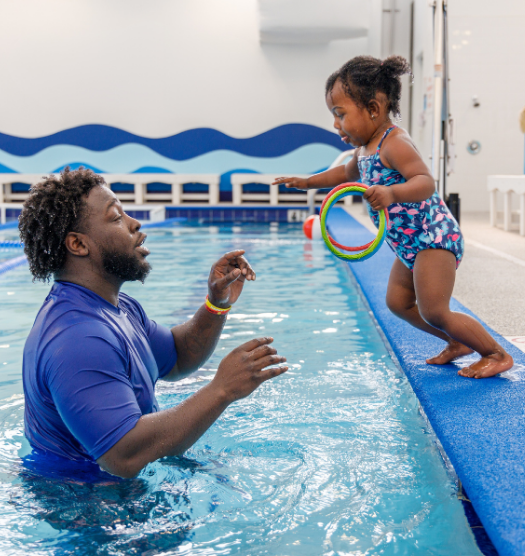
In ParentTot classes for children ages 4 to 36 months, a parent or caregiver participates in the water with the child. These classes are instructional: they build comfort and positive water routines while introducing breath control and supported front and back skills. The instructor will guide you through age-appropriate holds, cues, and activities so you can actively support your child's comfort and foundational skills.

In Toddler Transition classes for developmentally ready children ages 2 to 3, the child participates with an instructor without a parent in the water. Participating without a parent in the water may require an adjustment period, especially for children who are new to the class routine.

In children's group lessons, swimmers learn by watching peers demonstrate skills, listening to instructor feedback, and practicing alongside children at a similar level. Some of the first class is spent simply learning how the class works.

In private lessons, the instructor focuses the session on one swimmer's skills and goals.

In semi-private lessons, two swimmers share an instructor, combining more individualized feedback with the opportunity to learn alongside a sibling or friend.

If your child cries

Tears and hesitation can be a normal part of adjusting to early swim lessons. A child who cries at the first lesson is not failing at swim lessons, and neither are you.

Some things that tend to help:

  • Follow the instructor's guidance. Give the instructor an opportunity to begin the class, but remain available if your child's distress continues or intensifies.
  • Keep your response calm and predictable. If you are not participating in the water, follow the class routine and the instructor's guidance about where to wait.
  • Share useful context. Tell the instructor about previous water experiences, sensory sensitivities, or particular activities that concern your child. This can help the instructor choose an appropriate starting point and response.
  • Do not judge progress by one difficult lesson. Some children need time to become familiar with the instructor, environment, and routine. If distress continues across lessons, talk with the instructor about whether the class level, format, time, or approach should be adjusted.
  • Work on a smaller next step with the instructor. The next step might involve observing an activity, using a different entry, or beginning with a more familiar skill. Work with the instructor rather than introducing a different activity independently.

Some children genuinely dislike water on their face or the sensation of floating, and that is real information rather than something to push through. The timeline will look different for every child.

After the lesson

Ask what your swimmer practiced and what they will continue developing. SafeSplash instructors track each swimmer's skills and recommend advancement when the swimmer demonstrates the requirements for the next level. Swimmers earn level ribbons as they progress. Depending on the location, families may also receive progress updates through the SafeSplash app or attend Splash-N-Tell sessions where swimmers demonstrate what they have been learning.

Regular participation gives swimmers repeated opportunities to practice, become familiar with the class routine, and build on prior skills. Comfort, capability, and confidence can develop together over time.

What one lesson does not change

Swim lessons help children build water safety and swimming skills, but no lesson makes a child water-safe or replaces close supervision and other layers of protection. Infants, toddlers, and inexperienced swimmers should remain within arm's reach of a supervising adult in or around water.

The American Academy of Pediatrics recommends combining swim lessons with protections such as four-sided pool fencing, properly fitted life jackets when appropriate, and adults who know CPR.

Frequently asked questions

What happens at a first swim lesson?

A child's first lesson generally follows the regular structure for their assigned level. They will meet the instructor, become familiar with the class routine, and participate in age- and level-appropriate activities while the instructor observes their current skills and comfort.

How long is a swim lesson?

Lesson length depends on the class format and program. Check the class listing or your location's First Day information for the scheduled duration.

What should my child bring to their first swim lesson?

Bring a swimsuit and towel. Your location's First Day information will confirm whether goggles, a swim cap or hair tie, and a reusable swim diaper are required or recommended.

Can I watch my child's swim lesson?

Observation arrangements differ by facility. Your location's First Day page will confirm where parents and caregivers wait during the lesson.

Does a parent get in the water?

It depends on the class. In ParentTot classes for children ages 4 to 36 months, a parent or caregiver participates in the water. In Toddler Transition, developmentally ready children ages 2 to 3 participate with an instructor without a parent in the water.

What if my child cries at their first swim lesson?

Tears and hesitation can be a normal part of adjusting to early swim lessons. Follow the instructor's guidance, share any relevant context, and avoid judging long-term fit based on one difficult lesson. If distress continues, work with the instructor to identify an appropriate adjustment or next step.

Does my child need to know how to swim before their first lesson?

No. Hesitation, limited water experience, or nervousness may be reasons to look for a patient, age-appropriate program rather than signs that a child cannot begin.

How do I know what level to sign up for?

Try the SafeSplash Level Finder, then confirm with your local team. Placement considers age, current skills, and comfort in the water.

Find the right starting class

Use the SafeSplash Level Finder, then talk with your local team about your child's age, current skills, water experience, and goals. Before the first lesson, review your location's First Day page for arrival instructions, what to bring, and facility-specific details.

  Find a SafeSplash location  

5 Tips to Help Your Child Learn to Swim Faster

5 Tips to Help Your Child Learn to Swim Faster

Think about this…if your child swims with us once a week that is one half hour lesson a week. That would be like getting one 30-minute reading or...
Read More
How Long Does It Take to Learn to Swim?

How Long Does It Take to Learn to Swim?

If you’re thinking about swim lessons for your child, you’re probably asking: How long does it take to learn to swim safely?The short answer: it...

Read More
Why Swimming Should Be Your Child’s First Sport

Why Swimming Should Be Your Child’s First Sport

The Most Important Sport Isn’t Played. It’s Learned—in the Water. {% video_player "embed_player" overrideable=False, type='hsvideo2',...

Read More