Can Swimming Lessons Make Your Child Smarter? The Cognitive Benefits of Swimming
Learning to swim goes beyond just water safety—it can also enhance your child's cognitive development! Swim lessons offer your child a great mix of...
5 min read
SafeSplash Swim School : August 21, 2026
If you have ever looked at a swim school schedule and wondered how infant, beginner, intermediate, and advanced lessons fit together, you are asking a question almost every swim parent asks eventually. Levels are how a curriculum keeps track of what a swimmer is working on right now.
Here is how progression works at SafeSplash, what each stage focuses on, and how to figure out where your swimmer fits.
Class formats, schedules, and program availability differ by location, so your local SafeSplash team can confirm what is offered where you are.
Two different things are going on, and it helps to keep them separate.
Class levels track what a swimmer is working on right now. Each level focuses on a specific set of water safety and swim skills.
The 4 C's of Progress are SafeSplash's framework for describing how swimmers develop across our curriculum: Comfortable, Capable, Confident, and Competitive. Each stage aligns with a broader group of class levels, while specific placement is based on a swimmer's age, current skills, and goals.
| Stage of Progress | Levels it aligns with | What swimmers work on |
|---|---|---|
| Comfortable | Infant and toddler classes, Beginner 1 | Familiarity with the water, positive water routines, breath control, supported front and back skills |
| Capable | Beginner 2 through Beginner 4 | Foundational and increasingly independent self-rescue skills, floating, rollovers, safer entries and exits |
| Confident | Intermediate levels | Refining stroke mechanics and building the endurance to swim longer distances |
| Competitive | Advanced levels | Technique refinement, stamina, and personal performance goals |
A few things this table cannot show you, and they matter.
The 4 C's provide a path for continued progression, but not every swimmer has the same destination. Competitive supports swimmers who want to pursue advanced technique and performance goals, but it is not a required destination for every family. Becoming comfortable, capable, and confident in the water represents meaningful progress, whether or not a swimmer ever competes.
Not every swimmer begins at Comfortable. For infants and toddlers, the primary focus is often Comfortable. But a nine-year-old who has spent summers at a lake and an adult returning to the water after years away are starting from very different places, and level placement reflects that.
Progress is not always perfectly linear. Each stage aligns with a broader part of the curriculum, but comfort, capability, and confidence continue developing together as swimmers advance. A swimmer does not stop working on comfort when they become Capable or stop building confidence when they reach an Advanced level.
This is where the primary focus is often Comfortable. The earliest classes build familiarity with the water and establish positive routines, and they are genuinely instructional from the start.
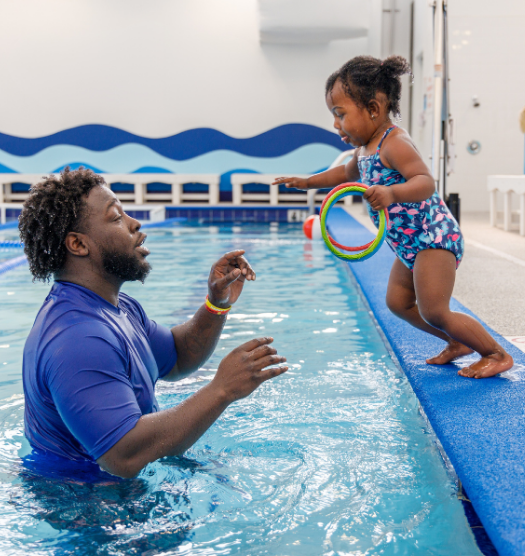
ParentTot classes are for children ages 4 to 36 months and include a parent or caregiver in the water with the child. They build comfort and positive water routines while introducing breath control and supported front and back skills.
Toddler Transition classes are for developmentally ready children ages 2 to 3. The child participates with an instructor without a parent in the water, taking on more independence while continuing to build safety and movement skills.
Beginner 1 focuses on trust, water familiarity, and the foundational skills that support later self-rescue skill development, whether or not the swimmer participated in an earlier program.
The two programs overlap during part of the 2-to-3-year-old age range and differ in whether a caregiver participates in the water. Class placement depends on the child's age, developmental readiness, current skills, and local program availability.
This is the band where swimmers build foundational and increasingly independent self-rescue skills, which is what Capable describes. It is also where the S.A.F.E.R. Swimmer Promise applies.
The S.A.F.E.R. Swimmer Promise gives qualifying swimmers ages 4 and older in Beginner 2 through Beginner 4 who meet consistent attendance requirements a clear goal: complete 10 essential water safety and self-rescue skills within one year or receive up to two additional months of lessons free. Program availability and eligibility requirements may vary by location.
The reason a program like this exists is that "how long will this take" is a question most families have, and the honest answer for any individual swimmer is that it depends. The Promise does not guarantee that every child will progress at the same pace. It gives eligible families a defined set of skills, a clear timeframe, and a measurable goal for the beginner stage.
Building self-rescue skills is meaningful progress. It is also not a guarantee. No age and no set of skills means a swimmer can reliably save themselves, and skills at this stage do not reduce the need for supervision or the other layers of protection around water.
Once a swimmer has foundational skills in place, the work shifts toward refinement, and Confident is often what families see growing here. Intermediate levels focus on refining stroke mechanics and building the endurance to swim longer distances.
At this stage, progress may become more technical and less immediately visible as swimmers refine stroke mechanics, improve efficiency, and build endurance. Instructor feedback and progress tracking can help families recognize those incremental gains.
Advanced levels are for swimmers refining technique, building stamina, and working toward personal performance goals, which is the territory Competitive describes. SafeSplash also offers clinics and team preparation options, including WAVE Swim Team Prep, generally designed for swimmers at Intermediate 2 and above.
Competitive swimming is one possible path, not a required goal for every swimmer.
SafeSplash instructors use curriculum-based skill tracking to evaluate each swimmer's progress, so advancement is based on demonstrating the skills required for the next level rather than spending a predetermined amount of time in a class. Swimmers may also earn level ribbons as they progress. Depending on the location, families may receive additional progress updates or be invited to Splash-N-Tell sessions where swimmers demonstrate what they have been learning. Ask your local team which progress and observation tools are available.
If you are not sure where your swimmer should start, the SafeSplash Level Finder can point you toward a level, and the team at your location can confirm placement.
A level tells you what a swimmer is working on. It does not tell you a swimmer is finished learning, and it does not change what has to be true around the water.
The American Academy of Pediatrics describes swim lessons as one layer of protection against drowning, alongside measures such as close supervision and four-sided pool fencing. Lessons can help reduce risk. They cannot prevent every drowning, and they do not replace supervision.
How do swim lesson levels work?
SafeSplash class levels group swimmers by the skills they are currently developing. The levels align with the 4 C's of Progress: Comfortable, Capable, Confident, and Competitive. Each stage corresponds with a broader part of the curriculum, from infant and toddler programs through Advanced lessons, while specific placement is based on a swimmer's age and current skills.
What are the 4 C's of Progress?
Comfortable, Capable, Confident, and Competitive. The 4 C's describe progression across the SafeSplash curriculum, from building comfort and foundational skills to refining technique and endurance. Competitive is available for swimmers pursuing advanced goals, but it is not every swimmer's required destination.
How long does a swimmer stay in one level?
Advancement at SafeSplash is based on demonstrating the required skills for the next level rather than completing a set number of weeks, so the timeline varies by swimmer.
What level should my child start in?
Try the SafeSplash Level Finder, then confirm with your local team. Placement considers age, current skills, and comfort in the water. A child does not need to already feel comfortable or confident in the water before starting.
Does my child need to be comfortable in the water before starting lessons?
No. Hesitation, limited water experience, or nervousness may be reasons to look for a patient, age-appropriate program rather than signs that a child cannot begin.
Is my toddler in ParentTot or Toddler Transition?
ParentTot is for children ages 4 to 36 months with a parent or caregiver in the water. Toddler Transition is for developmentally ready children ages 2 to 3 participating with an instructor without a parent in the water. The two overlap during part of the 2-to-3-year-old age range, so ask your local team which is the better fit.
What happens when a swimmer moves up a level?
Instructors track each swimmer's skills and recommend advancement when the swimmer demonstrates the requirements for the next level. Swimmers earn level ribbons as they progress. Depending on the location, families may also receive progress updates through the SafeSplash app or attend Splash-N-Tell sessions where swimmers demonstrate what they have been learning.
Talk with your local SafeSplash team about your child's age, current skills, comfort level, and goals. They can help identify an appropriate starting level and class based on local availability.
Learning to swim goes beyond just water safety—it can also enhance your child's cognitive development! Swim lessons offer your child a great mix of...
If you’re thinking about swim lessons for your child, you’re probably asking: How long does it take to learn to swim safely?The short answer: it...

As the summer comes to an end and the excitement of the new school year begins, many parents are gearing up for their kids to dive into fall sports....

Visit our Water Safety Blog for expert advice, family tips, and more!