<img height="1" width="1" style="display:none" src="https://www.facebook.com/tr?id=1224625332660204&amp;ev=PageView&amp;noscript=1">
Skip to the main content.

4 min read

Swim Team Prep and Stroke Development: The Next Step After Swim Lessons

Swim Team Prep and Stroke Development: The Next Step After Swim Lessons
wave

For many swim families, the question eventually changes. Instead of asking whether their child is building foundational skills, parents begin asking, "They love swimming. What comes next?"

The path from lessons to stroke development and competitive swimming is not always obvious from the outside. Here is how that progression works and where SafeSplash clinics and WAVE Swim Team Prep may fit.

Clinics and WAVE Swim Team Prep are offered at select SafeSplash locations. Program schedules, entry requirements, and available formats may differ, so the local team can confirm current options.

The short answer

After foundational skills are in place, instruction begins placing greater emphasis on stroke mechanics, efficiency, endurance, and increasingly advanced goals. At SafeSplash that progression runs through the Intermediate and Advanced levels, with clinics and team preparation options alongside them:

Program or level Who it is designed for Primary focus
Intermediate levels Swimmers who have completed foundational beginner skills Refining stroke mechanics and building the endurance to swim longer distances
Swim Stroke Clinics Advanced swimmers seeking focused technique work Refining specific stroke mechanics, efficiency, strength, and speed
Starts & Turns Clinics Swimmers preparing for competitive events Fundamentals of competitive starts and turns
WAVE Swim Team Prep Generally Intermediate 2 swimmers and above Competitive training concepts, endurance, coached practices, and technique across all four strokes
Advanced levels Swimmers pursuing higher-level technique and endurance goals Technique refinement, stamina, and personal performance goals

What "stroke development" actually means

In beginner levels, a swimmer learns to move through the water. In stroke development, they learn to move through it efficiently. That is a different skill, and it is why a child who can already swim a lap still has plenty to work on.

Stroke work generally covers:

  • Body position. Staying horizontal and streamlined in the water.
  • Breathing mechanics. Rotating to breathe in freestyle without breaking rhythm or lifting the head.
  • Catch and pull. Developing effective hand and arm mechanics through the underwater portion of each stroke.
  • Kick. Developing effective kick mechanics, rhythm, and propulsion appropriate to each stroke.
  • Timing. Coordinating arms, legs, and breathing so they support each other.
  • Efficiency. Learning to maintain effective technique while reducing unnecessary effort and movement.

At this stage, meaningful progress may appear in small technical changes to body position, timing, breathing, or efficiency that are not immediately obvious from the deck.

The four competitive strokes

Competitive swimming includes four strokes, each with distinct mechanics, timing, and technical demands:

Freestyle. Freestyle combines streamlined body position, coordinated arm and kick mechanics, and rhythmic breathing. It is commonly used for building speed and endurance.

Backstroke. Backstroke builds on comfort and body position on the back while adding rotation, coordinated arm recovery, consistent kicking, and awareness of the wall.

Breaststroke. Breaststroke requires precise coordination among the pull, breath, kick, and glide. Its kick and timing differ significantly from the other competitive strokes.

Butterfly. Butterfly requires coordinated body movement, arm recovery, kicking, breathing, and timing. Swimmers develop it according to their readiness, strength, and technique.

The order and pace at which swimmers develop the four strokes depend on their current skills, curriculum, and training goals.

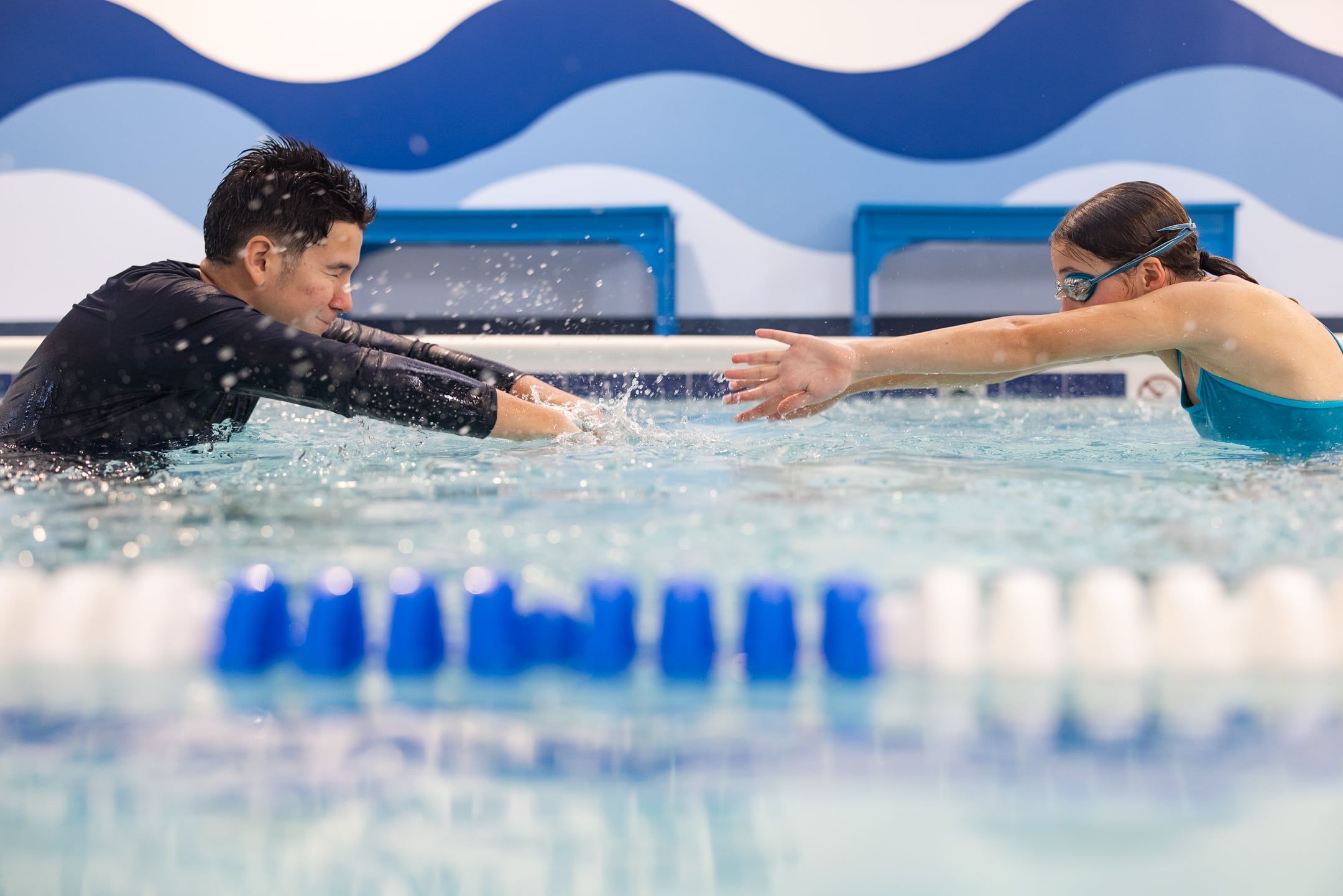
WAVE Swim Team Prep is a recreational team-preparation program generally designed for swimmers at Intermediate 2 and above. Through coached practices and intrasquad meets, swimmers build endurance, learn competitive training concepts, and refine efficient, legal technique across freestyle, backstroke, breaststroke, and butterfly.

Starts, turns, and the parts of racing that are not swimming

A meaningful portion of a race is not stroke work at all. Starts and turns are separate skills with their own technique, and they are often an area where a newer competitive swimmer can make gains.

SafeSplash Starts & Turns Clinics focus on the fundamentals of competitive starts and efficient turns at the wall.

Is my swimmer ready for team prep?

Current level placement is the primary starting point for WAVE, but technical readiness is only part of deciding whether the program is a good fit. Things worth talking through with your instructor:

Some swimmers move into team prep and love it. Some try it and prefer to keep swimming recreationally. Both are fine outcomes, and neither is a verdict on the swimmer.

Where this sits in the 4 C's of Progress

SafeSplash uses the 4 C's of Progress to describe how swimmers develop across our curriculum: Comfortable, Capable, Confident, and Competitive. Intermediate stroke development aligns with Confident, while Advanced lessons and competitive preparation align with Competitive.

The 4 C's provide a path for continued progression, but not every swimmer has the same destination. Some swimmers pursue Advanced lessons and competitive goals, while others build confidence, endurance, and strong technique without ever choosing to race. Both are meaningful outcomes.

Water safety does not graduate

Stronger skills expand what a swimmer can do, but they do not eliminate risk. Even advanced and competitive swimmers should:

  • Never swim alone and choose lifeguarded areas whenever possible
  • Follow facility rules for starts, diving, and water depth
  • Stay within their current skill, fitness, and endurance limits
  • Wear a properly fitted, U.S. Coast Guard-approved life jacket when boating and whenever conditions or the activity call for one
  • Recognize that currents, waves, cold water, sudden drop-offs, and limited visibility make open water different from a pool

Swim instruction and training build water competency, but no level of skill prevents every drowning or replaces appropriate precautions.

Frequently asked questions

What comes after swim lessons?

Once foundational skills are in place, swimmers may continue through Intermediate and Advanced lessons to refine stroke mechanics and build endurance. Depending on their level and goals, they may also explore focused stroke clinics, Starts & Turns Clinics, or WAVE Swim Team Prep.

What is WAVE Swim Team Prep?

WAVE Swim Team Prep is SafeSplash's recreational team-preparation program for swimmers generally at Intermediate 2 and above. It uses coached practices and intrasquad meets to build endurance, introduce competitive training concepts, and refine technique across all four competitive strokes.

What are the four competitive strokes?

The four competitive strokes are freestyle, backstroke, breaststroke, and butterfly. The order and pace at which swimmers develop them depend on their current skills, curriculum, and training goals.

At what level can my child start swim team prep?

WAVE Swim Team Prep is generally designed for swimmers at Intermediate 2 and above. Talk with your local SafeSplash team about your swimmer's current level and what the program looks like at your location.

What is a swim stroke clinic?

A focused session on technique. SafeSplash Swim Stroke Clinics refine specific stroke mechanics, efficiency, strength, and speed, while Starts & Turns Clinics cover the fundamentals of competitive starts and efficient turns at the wall.

Does my child have to join a swim team eventually?

No. Competitive is one of the 4 C's of Progress, not a required destination. Many swimmers build confidence, endurance, and strong technique without ever choosing to race.

Is it too late for an older child to start stroke development?

Older children can begin stroke development when they have the foundational skills required for the appropriate Intermediate or Advanced level. Placement is based primarily on current ability, so prior competitive experience is not required to begin refining technique.

Explore stroke development and team preparation

Talk with your local SafeSplash team about your swimmer's current level, technique, endurance, and goals. They can help determine whether continued lessons, a focused clinic, or WAVE Swim Team Prep is the most appropriate next step.

  Find a SafeSplash location.

Swim Lesson Levels Explained: How Swimmers Progress Through Each Stage

Swim Lesson Levels Explained: How Swimmers Progress Through Each Stage

If you have ever looked at a swim school schedule and wondered how infant, beginner, intermediate, and advanced lessons fit together, you are asking...

Read More
4 Reasons to Sign Your Special Needs Child Up for Swim Lessons

4 Reasons to Sign Your Special Needs Child Up for Swim Lessons

Swimming lessons are a typical part of growing up for most kids, especially for those who live near a pool or in a home with one. These lessons teach...
Read More
From the Pool to the Field: How Swim Lessons Give Your Child the Edge in Fall Sports

From the Pool to the Field: How Swim Lessons Give Your Child the Edge in Fall Sports

As the summer comes to an end and the excitement of the new school year begins, many parents are gearing up for their kids to dive into fall sports....

Read More