
A Guide to Setting Boundaries with Your Kids
 Amy Boyington : July 27, 2021
Ask a group of parents or caregivers what their biggest challenge is with their kids, and setting boundaries will probably be a common pain point....
5 min read


Most parents do not need another warning about screen time or achievement pressure. They need practical ways to help their children build confidence, resilience and meaningful connection in a world that often pulls them in the opposite direction.
That is the idea behind the Generation Real Project.
Led by Youth Enrichment Brands, SafeSplash’s parent company, Generation Real brings together youth organizations and child-development experts around a shared goal: creating more of the hands-on, real-world experiences that help children grow with confidence, resilience and joy.
The project is not about rejecting technology or giving parents another impossible standard to meet. It is focused on what families and communities can give children: opportunities to participate, connect, work through challenges and experience progress for themselves.
The first practical resource from the project is the Generation Real Essential Reading List, featuring eight books selected by Youth Enrichment Brands CEO Rob Price and expert advisors Erica Komisar, LCSW, and Jennifer Breheny Wallace.
The books are organized around four challenges families may be navigating right now, making it easier to find a useful place to begin.
At SafeSplash, we see every day that confidence is built through experience.
In the pool, children have to be fully present. They listen to their instructor, practice a tangible skill, respond to feedback and keep working when something does not come easily. Their progress is not something they passively watch. It is something they experience for themselves.
Swim lessons will not solve the screen-time conversation or eliminate the pressures children face. But they give kids something real: meaningful connection, measurable progress and practical water safety skills they carry with them.
That perspective makes the four themes in the Generation Real Essential Reading List especially relevant to SafeSplash families.
The Anxious Generation by Jonathan Haidt
Jonathan Haidt examines how the shift from a play-based childhood to a phone-based childhood has affected adolescent development and mental health. He also offers practical recommendations for restoring more independence, face-to-face interaction and real-world play.
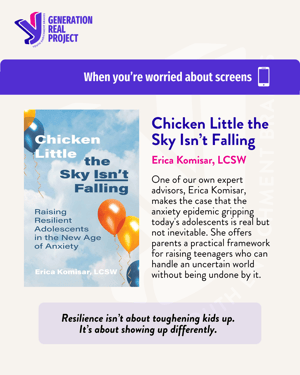 Chicken Little the Sky Isn’t Falling by Erica Komisar, LCSW
Generation Real advisor Erica Komisar explores the rise in adolescent anxiety and explains how parental presence, emotional honesty and manageable challenges can help children develop resilience. Her guidance encourages parents to support children through uncertainty without immediately removing every struggle from their path.
What this looks like at SafeSplash
Swim lessons create dedicated time for children to engage with the physical world.
A swimmer has to listen, move, respond and practice. They cannot passively consume the experience or fast-forward through the difficult parts. Learning requires active participation and sustained attention.
Technology is not the enemy, and swim lessons are only one part of a child’s week. But time spent learning in the pool gives children something screens cannot replicate: the physical experience of developing a skill through their own effort.
Free-Range Kids by Lenore Skenazy.png?width=300&height=375&name=3%20(1).png)
Lenore Skenazy makes a research-backed case for giving children appropriate freedom to explore, make mistakes and become more independent. She challenges fear-based parenting habits and demonstrates how thoughtfully stepping back can help children recognize their own capabilities.
Untangled by Lisa Damour, Ph.D.
Lisa Damour helps parents understand the developmental transitions adolescent girls experience as they move toward greater independence. She reframes behaviors such as seeking privacy and taking more ownership of decisions as important parts of growing up, while helping parents recognize when a child may need additional support.
What this looks like at SafeSplash
Confidence is not created by simply telling a child they are capable. It grows when they experience their own capability.
Instructors provide the environment, guidance and support, but the swimmer ultimately has to perform the skill. They put their face in the water. They push away from the wall. They work toward greater independence one step at a time.
The right level of support helps a child feel secure without doing the work for them. Each new skill becomes evidence they can draw from the next time something feels difficult.
.png?width=300&height=375&name=4%20(1).png) Never Enough by Jennifer Breheny Wallace
Never Enough by Jennifer Breheny Wallace
Generation Real advisor Jennifer Breheny Wallace examines the effects of achievement culture on children and families. Her research centers on “mattering,” the need for children to feel valued for who they are rather than only for what they accomplish. The book gives parents practical ways to encourage healthy motivation without tying a child’s worth to performance.
The Inner Game of Tennis by W. Timothy Gallwey
Although written through the lens of tennis, this influential book applies far beyond the court. Gallwey explores focus, self-awareness and the effect of the inner critic on performance. It offers useful perspective for parents who want children to pursue growth without becoming consumed by perfectionism or fear of failure.
What this looks like at SafeSplash
Swimming gives children measurable ways to recognize progress, but meaningful progress is personal.
A child does not need to be the fastest swimmer in the pool to experience success. A milestone might be putting their face in the water, floating independently, reaching the wall or mastering a skill that once felt impossible.
The goal is capability, not superiority.
When adults recognize consistency, courage and effort alongside outcomes, children learn that progress matters without believing their worth depends on being perfect. They can feel proud of what they have accomplished while understanding that learning is still in progress.
Together by Vivek H. Murthy, MD
Former U.S. Surgeon General Vivek Murthy explores loneliness as a widespread health challenge and makes the case that meaningful human connection is essential to well-being. The book encourages families and communities to prioritize the relationships and shared experiences that help people feel known, supported and valued.
Brainstorm by Daniel J. Siegel, MD
Daniel Siegel explores the development of the adolescent brain and reframes the intensity, novelty-seeking and growing independence of the teenage years as sources of possibility. By better understanding this stage of development, parents can respond with greater empathy and remain connected as their children grow.
What this looks like at SafeSplash
Learning to swim is an individual journey, but it does not happen in isolation.
Children build relationships with instructors who learn when to challenge, encourage and support them. They practice near other swimmers who are also working through uncertainty. They watch others try, celebrate progress and experience what it means to participate in something happening in the real world.
These interactions may seem small, but they give children repeated opportunities to feel known, supported and connected.
The Generation Real Essential Reading List is intended to be useful, not become another assignment for busy parents.
You do not need to read all eight books or follow a particular order. Start with the question that feels most relevant to your family:
Choose one book. Read one chapter. Start a conversation. Try one small change.
That change could mean putting phones away during a shared activity, giving your child one new responsibility, recognizing persistence instead of only the outcome or creating more room for an experience that asks your child to be fully present.
The experiences children carry with them are often the ones that ask them to try, listen, practice and discover what they can do.
At SafeSplash, we see those experiences take shape in the pool every day. A skill that once felt difficult begins to click. Progress builds confidence, and confidence changes what a child believes is possible.
Swimming is only one way to create those moments. The broader goal of Generation Real is to help families find more opportunities for children to participate, connect and grow through meaningful experiences in the real world.
The Generation Real Essential Reading List gives families a practical place to start.
Download the Generation Real Essential Reading List
The reading list is an early release from the upcoming Generation Real Playbook, a free, action-oriented resource for families. Additional tools and guidance will be shared as they become available.
Amy Boyington : July 27, 2021
Ask a group of parents or caregivers what their biggest challenge is with their kids, and setting boundaries will probably be a common pain point....

The fact that kids lie probably won’t come as a shock to many parents.
.png)
Swimming lessons are a typical part of growing up for most kids, especially for those who live near a pool or in a home with one. These lessons teach...

Visit our Water Safety Blog for expert advice, family tips, and more!